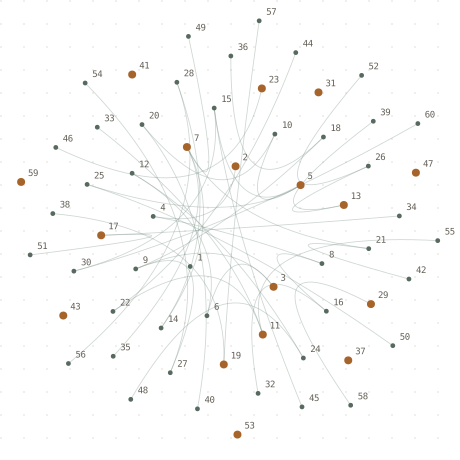
PRIMES / FACTOR ANCESTRY, n ≤ 60 Each composite connects to the number left after removing its smallest prime factor. Positions are illustrative; connections are arithmetic.
Computation as explorationArguments open to scrutinyFormal proofs with explicit scope
Current research / 01
Robin’s inequality places a precise limit on the sum of a number’s divisors. It holds for every whole number greater than 5,040 if and only if the Riemann Hypothesis is true.
We study how often that limit could fail, and build formally checked tools for investigating it.
From zeta zeros to Robin candidates.
Manuscript v1.2 · revised 27 October 2026 (CDT) Finite milestone · 25 October 2026
Spectral bounds for the number of Robin candidates
A quantitative counting argument connecting estimates for zeta zeros, a centered Mertens identity and prime-support patterns. The manuscript is open for scrutiny. The shell/profile construction and canonical finite certification are separate follow-ups; the full analytic theorem remains outside that formalization.
For every real cutoff y in [100000, 102000], the actual canonical N(y) is greater than 5040 and strictly satisfies Robin’s inequality. A reusable generator and kernel checker certify complete events, exact ties and a compensated margin budget. This does not describe every integer in that numerical interval or prove a global sign result.
The consolidated research also includes a completed finite prime-support certificate and the closed Plimpton E1–E3 experiments, including their negative findings. Explore the research and its evidence →
How the project works
Explore. Test. Make the argument.
01 / REPRESENT
Make relationships visible.
Explore factorization, divisibility, residues and graphs in finite sets of integers. Use the pictures to formulate precise questions.
02 / INVESTIGATE
Test what survives.
Check proposed patterns against reproducible computations, comparison cases and counterexamples.
03 / VERIFY
State exactly what is proved.
State the assumptions, prove what follows, and identify what remains unresolved. Invite independent scrutiny.
An invitation to look closely
A precise objection is progress.
We welcome checks of individual arguments, missing hypotheses and references to earlier results. You do not need to review an entire manuscript to contribute.